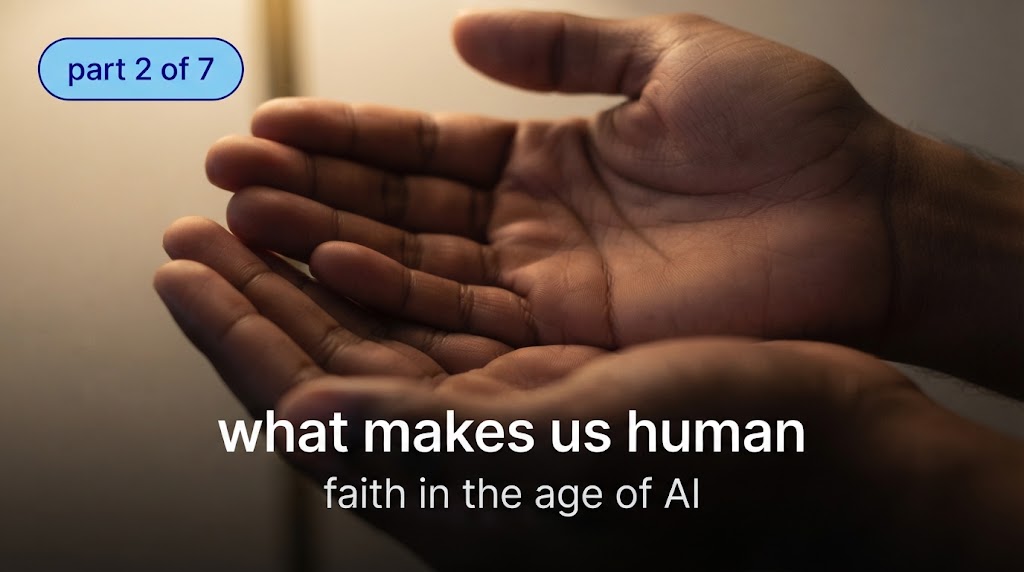

Ask an AI chatbot to write you a poem, comfort you after a hard day, or hold a conversation, and it can do a startlingly convincing job. That is exactly why this post matters. If a machine can talk like us, write like us, and even sound empathetic – what actually makes us human? Scripture’s answer has not changed: we are made in the image of God, and that is not something intelligence or output can replicate.
It is tempting to define “human” by what we can do—think, create, reason, and communicate. But that is precisely the ground AI is encroaching on. If being human is just about capability, the line ceases to exist. Scripture points somewhere else entirely.
Made in the Image of God, Not Just Intelligent
Genesis 1:27 says, “So God created mankind in his own image, in the image of God he created them; male and female he created them.” Notice what this verse does not say. It does not say humanity was made intelligent in God’s image, or productive, or articulate. (I dodged a bullet here.) It says we bear His image—a reflection of His character, His relational nature, and His capacity for love and moral responsibility.
An AI model can process billions of words and predict the next likely sentence with impressive fluency. But it does not bear anyone’s image. It has no moral agency, no soul, no capacity to love or be loved. It mimics the outputs of being human—words, images, even tone—without any of the substance behind them.
Known, Not Just Processed
Here is where it gets personal. Psalm 139:1-4 says, “You have searched me, Lord, and you know me… Before a word is on my tongue you, Lord, know it completely.” That is not describing data processing. That’s describing being known—fully, intimately, by name.
AI can process what you type. It can even personalize responses based on patterns in your data, so much so you feel that it knows you. But it does not know you the way the psalmist describes—it has no history with you, no love for you, no stake in your well-being. There is a world of difference between a system that predicts what you might say next and a God who knew you before you said anything at all.
Why This Distinction Actually Matters
This is not just theological trivia. If we quietly start defining human worth by output—how smart, how productive, how impressive we sound – then increasingly capable AI will always feel threatening, because it can out-produce us in narrow tasks. But if human worth is rooted in being made in the image of God, nothing artificial can touch it. Your value was never based on being the fastest or most articulate voice in the room. (I dodged another bullet here.)
This also shapes how we treat each other. If people are worth honouring because they bear God’s image—not because of what they can produce—that is a truth AI cannot erode, no matter how capable it becomes.
A Question to Sit With
Where have you been tempted to measure your worth by output—productivity, intelligence, how impressive you sound? Being made in the image of God is not earned by performance. It was given.
I invite you to say this prayer.
Father, thank You that I bear Your image—not because of what I produce, but because You made me and know me by name. When I am tempted to measure my worth against what a machine can do, remind me that my value was settled before I did anything at all. Help me see others the same way—as image-bearers, not performers. Amen.
This is Part 2 of a 7-part series, “Not a Surprise to God: Faith in the Age of AI.” Part 1, “AI Is Not a Surprise to God,” published Monday, September 7. Part 3, “Information Isn’t Wisdom,” publishes Friday, September 11.
Leave a Reply